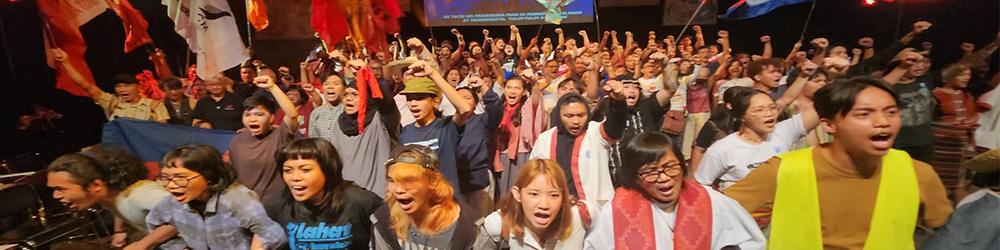
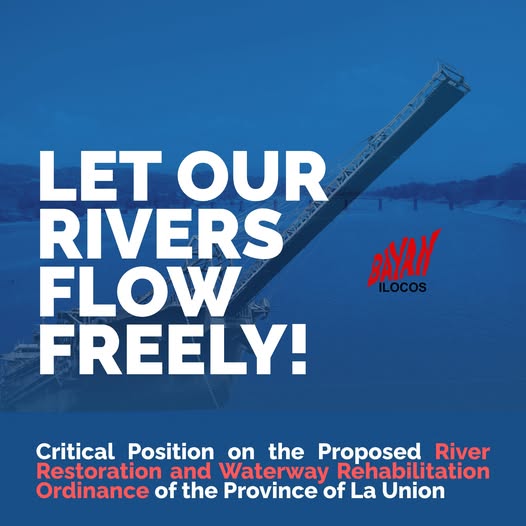
Bagong Alyansang Makabayan (BAYAN) Ilocos submits this formal position paper regarding the proposed River Restoration And Waterway Rehabilitation Ordinance currently under deliberation by the Sangguniang Panlalawigan ng La Union.
We believe that the aforementioned ordinance, which presents itself as a measure to protect the environment, contains fundamental contradictions that serve extractive interests over genuine ecological restoration. This position paper outlines our substantive concerns and demands immediate corrective action from the Provincial Government.
1. The ordinance recognizes principles of ecological rights and restoration at the same time as it undermines them by allowing commercial extraction from river systems. These mutually exclusive objectives cannot coexist within a single regulatory framework without one inevitably compromising the other. Historical precedent demonstrates that when economic extraction and environmental protection share the same space, extraction invariably prevails through loopholes and weak enforcement.
2. Public consultation is included in the text of the ordinance, yet democratic rights are systematically weakened through procedural waivers and the complete absence of any real veto power for affected communities. Consultation without consequential authority reduces community participation to ceremonial observance. Affected families—fisherfolk, farmers, residents of riverside barangays—must possess the legal right to reject projects that threaten their livelihoods and ecosystems.
3. Fisherfolk, farmers, indigenous peoples, and other stakeholders are mentioned in the ordinance but without strong livelihood protection, adequate compensation mechanisms, or clear benefit-sharing arrangements with the community. Their names serve as decoration while their futures remain unprotected. Any environmental policy must prioritize those whose daily survival depends directly on healthy waterways.
4. The ordinance references nature-based solutions to make the language appear environmentally responsible. However, overall and structurally, it favors dredging and engineering interventions that allow private contractors to capture resources from riverbeds and watersheds. True ecological approaches would empower community stewardship rather than subcontracting ecosystem management to profit-seeking entities.
5. Monitoring bodies have been created in the proposed legislation, though typically such bodies are government-led with no guarantee that affected communities and people’s organizations will have meaningful voice in decision-making processes. Without independent community representation in monitoring frameworks, oversight becomes performative rather than protective.
6. The capitalization requirement for proponents is set at prohibitively high levels, making it clear that this ordinance serves only large businesses with substantial financial backing. Meanwhile, community-based stewardship initiatives—which would be more favorable to citizens and grounded in generations of local ecological knowledge—struggle to gain legal access due to financial barriers.
7. Under this ordinance, rivers serve a dual purpose for the Provincial Government of La Union, yet these two purposes remain fundamentally conflicting. While the text states there is a need to protect rivers, the provincial government is simultaneously creating pathways for provincial revenue generation and taxable extractive value from the same waterways. Fiscal incentives cannot coexist with conservation imperatives.
8. It becomes dangerous that through this proposed ordinance, dredging, quarrying and black sand mining now have explicit legal bases instead of being prevented or restricted. This legalization occurs through soft language like “restoration” and “sediment management” that obscures extractive intentions. Regulatory euphemisms serve to normalize activities that should remain prohibited.
9. The proposed ordinance places ecological burdens on barangays and affected communities while control, permits, and benefits remain concentrated with the Provincial Government and contractor networks. Environmental devastation is dumped on vulnerable communities while financial profits flow exclusively to corporate elites. This inversion perpetuates historical patterns of environmental injustice and resource exploitation.
In summary, BAYAN-Ilocos once again asks: who is this proposed ordinance really for? It is necessary for the Provincial Government to clarify whether they stand with elites, contractors, and state revenue interests, or with providing environmental and equitable justice for the citizens of La Union. This clarification must come before further deliberation proceeds.
Based on these considerations, BAYAN- Ilocos respectfully demands the following from the Provincial Government of La Union:
1. Immediate suspension of deliberation on the current draft pending comprehensive revision informed by genuine community consultation.
2. Establishment of a co-legislative process wherein affected communities, people’s organizations, and grassroots coalitions participate as equal partners in drafting protective measures.
3. Removal of all provisions enabling commercial extraction from protected river systems and watershed areas.
4. Guarantee of binding community veto power through legal mechanisms enforceable in court.
5. Restructuring of monitoring bodies to ensure majority representation from affected communities with independent budget allocation.
6. Reduction of capitalization requirements to enable community-based stewardship programs.
7. Separation of revenue-generation mandates from environmental-protection mandates to eliminate inherent conflicts of interest.
8. Prohibition of river-dredging, quarrying and black sand mining under any guise including restoration or sediment management terminologies.
9. Establishment of enforceable compensation and benefit-sharing agreements for impacted livelihoods prior to project approval.
10. Public disclosure of all contractor bids, permits, and revenue projections related to river-related projects for transparency and accountability.
The rivers of La Union belong not to the Provincial Government, nor to private contractors, but to the generations of communities who have lived along their banks, fished in their waters, and cultivated their floodplains. This ordinance represents a choice between serving elite extractive interests or protecting environmental and social justice for all citizens.
We call upon the Provincial Government to choose wisely, act transparently, and govern in true service to the people of La Union.