Under the 1987 Philippine Constitution, foreign military bases are prohibited, and this led to the dismantling of US military bases in Subic and Clark in 1991.
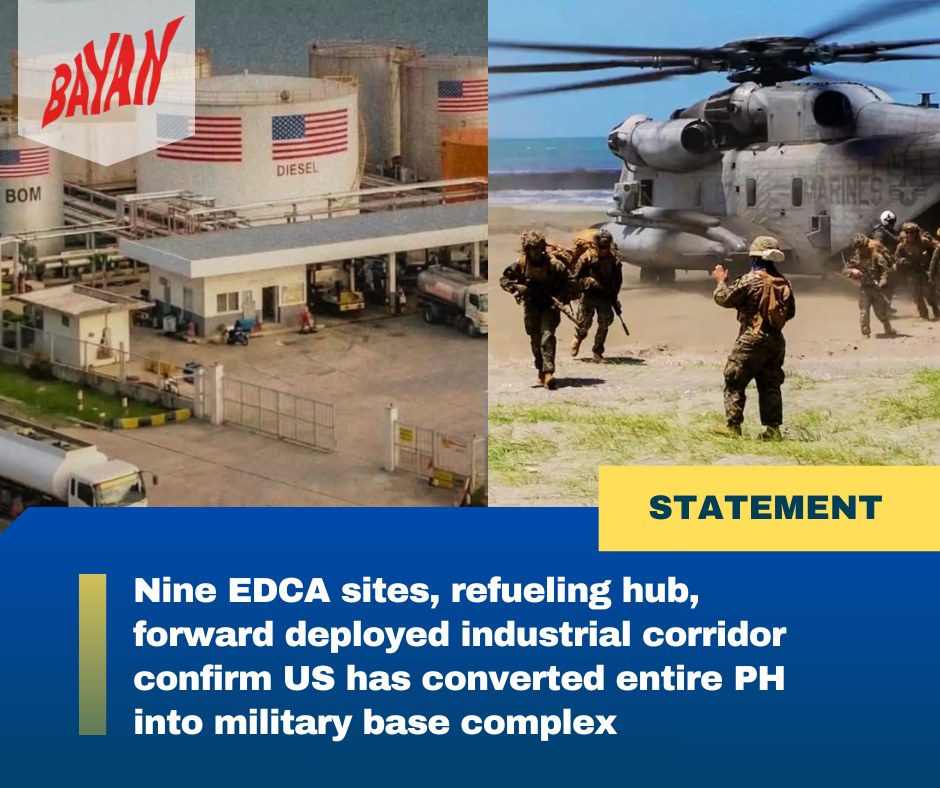
In 1999, the Visiting Forces Agreement (VFA) allowed for the permanent presence of US troops in the country in the guise of rotational deployment. In 2002, the Mutual Logistics Support Agreement (MLSA) was signed and renewed, which already allows the US military to access Philippine facilities and resources. In 2014, the Enhanced Defense Cooperation Agreement (EDCA) allowed the US to establish facilities in at least five mutually agreed locations. In 2022, Marcos Jr. expanded EDCA sites to nine.
Before the end of Biden’s term in 2024, the US built a so-called “combined coordination center” inside Camp Aguinaldo to foster faster intelligence sharing.
Marcos Jr. signed the Bilateral Defense Guidelines in 2024 and entered into a Trilateral Cooperation with the US and Japan. The latter showcased the unveiling of the Luzon Economic Corridor, which will facilitate the US military buildup on the country’s biggest island.
The US Marines bragged that after 32 years, it has reestablished its presence in Subic by leasing a warehouse in the former naval base. The US brought its Typhon Missile into the country and parked it at Laoag Airport. US Naval and shipyard repair facilities were reported in Batanes and Palawan. None of these locations is covered by EDCA.
The Philippines has recently agreed to the US proposal to build a refueling depot in Davao. The US said that for the first time, it recently conducted a “maritime prepositioning operation” from Cagayan de Oro to Subic using commercial barges.
Trump said the US government plans to build an ammunition factory and depot in Central Luzon.
In February, the Philippines signed a critical minerals deal with the US, which would further entrench the plunder of the country’s resources. The Philippines later joined the US-led Pax Silica and offered a 1,600-hectare “Economic Security Zone” in New Clark City to meet the high-tech production needs of the US military.
Philippine officials said the deal will spur the country’s industrial development, but the US government has repeatedly stated its military objectives. US Undersecretary of State Jacob S. Helberg called the Pax Silica Economic Security Zone a “forward deployed industrial base,” which is a military term for logistics operations. He even candidly posted on social media that the base is “roughly one-third the size of Manhattan—the equivalent of everything from Times Square south to the very tip of the island.”
Under the Marcos administration, the Philippines became an expanded training ground for the US-led coalition, and the whole country was turned into a large forward operating base of US military forces.
Marcos has recklessly and treasonously allowed the US to escalate tension in the region to justify intensified US military meddling.
Filipino and US officials are being disingenuous in their claim that there are no existing US military bases in the Philippines, like Subic and Clark, in the past. But the increasing number of facilities, hubs, depots, and industrial sites that are operated and maintained as de facto US bases says otherwise.
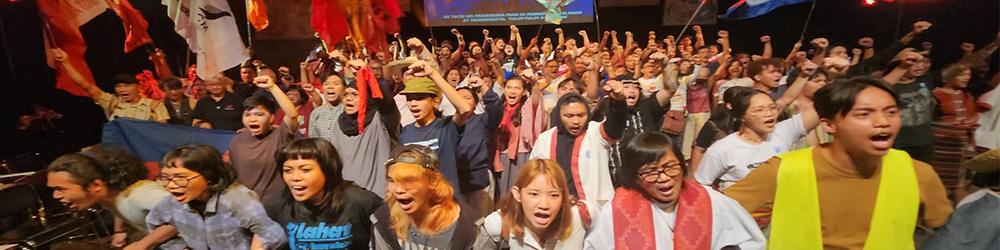
Bagong Alyansang Makabayan calls on all Filipinos to protest the ongoing Balikatan exercises, denounce the puppetry of the bureaucrat capitalist regime of Ferdinand Marcos Jr., resist US militarism and warmongering, and struggle for genuine independence from US imperialist domination and intervention.