For 25 years, the Electric Power Industry Reform Act (EPIRA) has burdened the Filipino people with soaring electricity rates, entrenched monopoly control over the energy sector by favored oligarchs, and deepened the country’s energy insecurity.
Since EPIRA was enacted into law on June 8, 2001, the promises of cheap electricity, genuine competition, and energy security have been thoroughly exposed as false. Rather than reforming the power sector in favor of consumers, EPIRA facilitated the wholesale transfer of the industry from a corrupt state monopoly to an even more rapacious private monopoly under the banner of neoliberal restructuring and privatization.
Onerous rates and monopoly control
The harsh impacts of EPIRA on the Filipino people are undeniable. As of March 2026, residential electricity rates in the Philippines reached ₱13.80 per kilowatt-hour (kWh). According to a recent report by the London-based energy think tank Ember, which cites data from the Department of Energy (DOE), this makes Philippine electricity the most expensive in Southeast Asia and among the highest in Asia. Additionally, based on the latest available data, the average residential electricity bill in Metro Manila accounts for more than 7% of the minimum wage, which is also the highest in Southeast Asia. Our neighbors in the region generally have a higher minimum wage and lower electricity rates.
Driving the country’s exorbitant electricity costs is the consolidation of the power industry in the hands of a few dominant conglomerates, a process facilitated by EPIRA. Today, because of the privatization of power generation under EPIRA, just six groups control over 70% of the country’s total installed generating capacity: Aboitiz Group (24%), San Miguel Corporation (20%), Lopez Group (12%), Meralco/Pangilinan Group (8%), and the Ayala Group (5%). Our energy security is at the mercy of unaccountable, profit-oriented oligarchs.
Note also that EPIRA allowed power distribution utilities, which already exercise monopoly control over their franchise areas, to own and run power generation plants. Meralco, which holds more than 8% of installed capacity, has a captive market of more than 8 million residential, commercial, and industrial customers in 39 cities and 72 municipalities in Metro Manila, Bulacan, Cavite, and Rizal. The largest power generator, the Aboitiz Group, operates several distribution utilities, including Davao Light, Visayan Electric, and Cotabato Light, which collectively serve a franchise area spanning 7 cities and 9 municipalities, with around 1 million residential, commercial, and industrial customers.
Meanwhile, transmission from power plants to the distribution utilities under the National Grid Corporation of the Philippines (NGCP) is also a monopoly controlled by oligarchs led by Henry Sy Jr., in partnership with China’s State Grid Corporation.
EPIRA heavily protects the interests of these oligarchs by institutionalizing a “pass-through” pricing regime that shields private corporations from risk while forcing consumers to shoulder virtually all costs, including fuel price hikes, currency fluctuations, and system losses arising from corporate inefficiency. Under this system, private profits are assured by passing on all the burden and costs directly onto the Filipino people.
Role of imperialist financial institutions
We must not forget that EPIRA was never the result of a power industry development program and planning as demanded by the Filipino consumers. The law was aggressively pushed by imperialist financial institutions such as the Asian Development Bank (ADB), the World Bank, and the Japan Bank for International Cooperation (JBIC), which tied new loans for the debt-ridden National Power Corporation (NAPOCOR) to the law’s enactment and implementation. These are the foreign creditors who sought to ensure that the state power corporation could repay its debts by privatizing all its assets, including power plants and transmission facilities that the oligarchs had taken over.
Twenty-five years after EPIRA was signed, NAPOCOR still has a staggering P261 billion in debt it needs to settle. Under EPIRA, the government set up the Power Sector Assets and Liabilities Management Corporation (PSALM) to oversee the sale of NAPOCOR’s assets. Since 2001, PSALM has generated almost P960 billion in privatization proceeds, but a large portion of this money had already been funneled to pay interest charges, operational losses, and a mountain of other financial obligations. The power oligarchs and foreign creditors have been squeezing the Filipino dry in the past 25 years.
Marcos Jr.’s accountability
The administration of President Ferdinand Marcos Jr. must be held accountable for continuing to implement EPIRA and for worsening the country’s energy crisis. Instead of taking on the mandate to build and operate power plants to meet the country’s energy needs, it has continued to rely on the oligarchs to develop the country’s energy program. PSALM’s corporate life was supposed to expire on the 25th anniversary of EPIRA, but Marcos Jr. decided in April last year to extend it until 2036, which prolongs the power privatization treadmill for another decade. The regime is also overseeing the privatization of the remaining NAPOCOR assets, such as the 796.64-megawatt (MW) Caliraya-Botocan-Kalayaan (CBK) hydroelectric power plant, which Marcos Jr. turned over to the Aboitiz Group earlier this year. Despite many documented cases of abuse, Marcos Jr. also extended in April 2025 the franchise of Meralco for another 25 years.
EPIRA is clearly the product of collusion among imperialist financial institutions, comprador big business interests, and bureaucrat-capitalist politicians and regimes who ensured the massive profits of power oligarchs and multilateral banks through the privatization of the electric power industry.
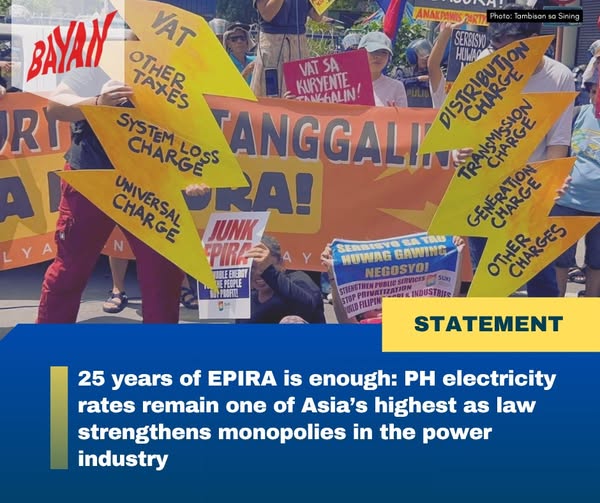
Beyond the excessive costs imposed by EPIRA on consumers, Marcos Jr. is also accountable for continuing to burden electricity users with a wide range of onerous taxes and charges. Chief among these is the 12% value-added tax (VAT), which is not imposed just once on the total monthly electricity bill but is charged separately on various components, making the costs even more oppressive.
Repeal EPIRA, reverse privatization
In the midst of worsening economic hardship and energy insecurity, the Marcos Jr. administration has shown itself both incapable and unwilling to protect the Filipino people. Its response to the crisis remains anchored on the same failed formula of greater privatization and expanded profits for his cronies and favored oligarchs in the energy industry.
We reiterate our call for the repeal of EPIRA and the reversal of decades of power privatization policies. Electricity is a basic social necessity indispensable to ensuring a decent standard of living for the people. It is likewise a vital foundation for genuine national industrialization and national development. Power should not be treated as a mere commodity to be exploited for monopoly profits by a handful of oligarchs.
The state must reclaim strategic control over the power sector and build a genuinely public, accessible, affordable, reliable, and people-oriented electric power industry that serves national development and the welfare of the Filipino people. ###