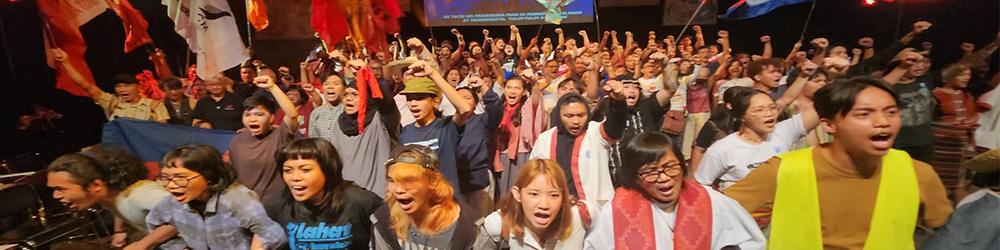
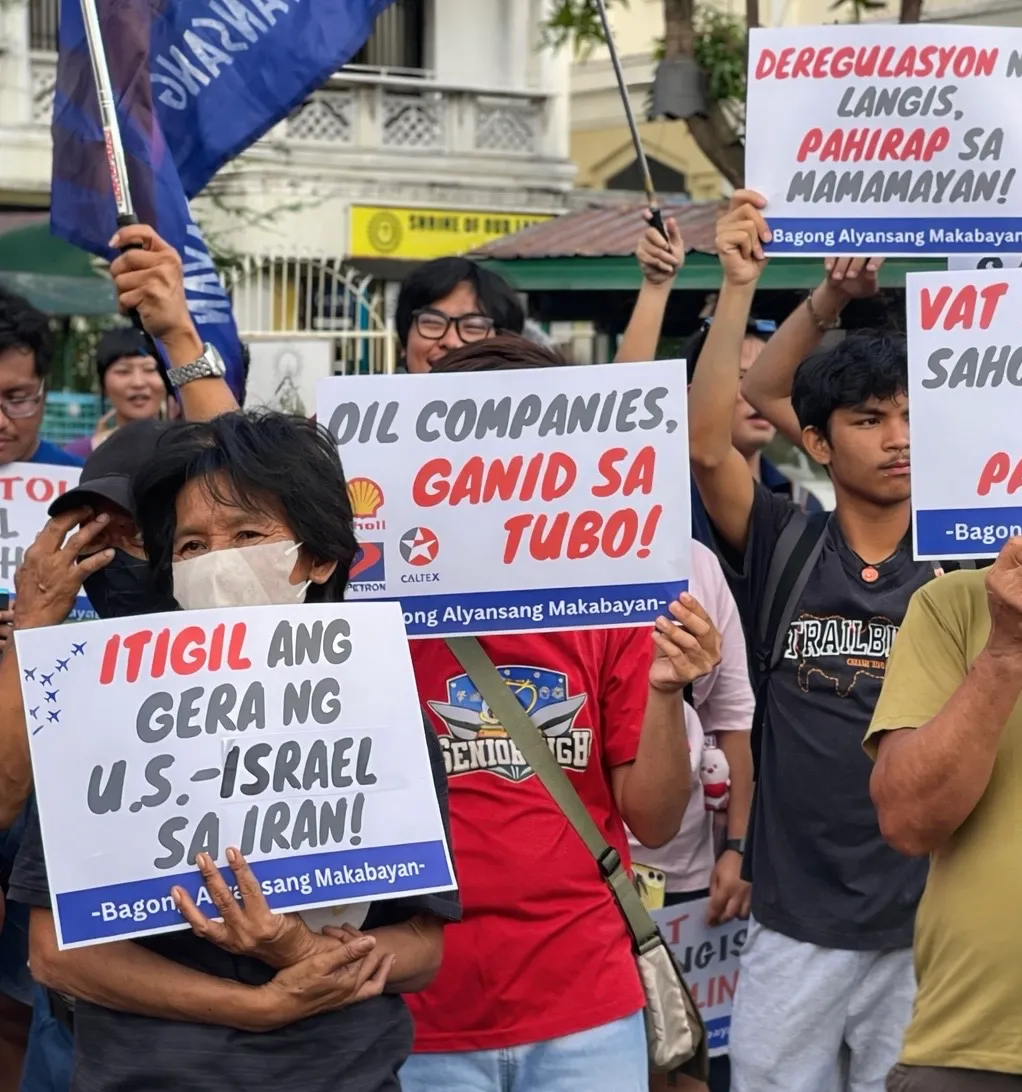
DEFEND THE PEOPLE’S FREEDOM AND LIVELIHOODS!
Filipino people’s demands for immediate relief and long-term reforms amid imperialist war and oil crisis
The escalating imperialist war waged by the US and Israel on Iran is driving the current global oil price shock, with domestic pump prices in the Philippines breaching the P100-per-liter mark. This unjust and destructive war, carried out in the name of US global hegemony and control over the world’s territories and resources, including oil, is not only killing and displacing millions of Iranian people. The war is also massively destroying the lives and livelihoods of billions of poor and working people around the world.
Millions of Filipino workers, especially those in the public transport sector, farmers, fishers, urban poor, and other vulnerable social sectors, are facing the unbearable burden of record-high oil prices caused by the US imperialist war of aggression. In the first two weeks of the crisis, the pump price of diesel has soared by almost 66%, while that of gasoline has ballooned by more than 37%. Oil prices are expected to further skyrocket with the brazen bellicosity of the Trump and Netanyahu regimes to advance their regime change agenda in Iran.
The Marcos Jr. regime has been proven incompetent in addressing the rapidly deteriorating crisis and its impacts on the people. The steps it has undertaken so far, such as asking Congress for emergency powers to conditionally suspend or reduce the excise taxes on petroleum products, implementing a four-day workweek for government agencies, appealing to oil firms to stagger the massive price hikes, and providing inadequate cash assistance to a few targeted sectors, are all band-aid measures disproportionate to the severity of the crisis.
The Philippines is fully exposed to volatile global oil markets because, one, it is 100% dependent on oil imports, and two, it has fully deregulated its downstream oil industry in compliance with the prescriptions in the 1990s of the US-led financial institutions, the International Monetary Fund (IMF), and the World Bank. The urgency of the crisis and its trajectory compel the government to take bold and extraordinary actions to stabilize domestic prices, provide various forms of immediate and sufficient economic relief, reform the oil industry, and begin addressing the structural roots of our extreme vulnerability to global oil shocks.
1. OPPOSE IMPERIALIST WARS OF AGGRESSION
The current oil crisis stems directly from the escalating US imperialist campaign to secure global dominance over territories and resources. We condemn the US‑Israel assault on Iran as unlawful, unprovoked, and a clear violation of Iran’s sovereignty. Claims of “imminent threats,” missile neutralization, and a revived nuclear program are manufactured pretexts for aggression that now devastate the lives and livelihoods of poor and working people worldwide, including Filipinos. We demand an immediate end to this unjust and destructive war and stand in solidarity with the people of Iran in defending their right to sovereignty and self‑determination.
We also reject the Marcos Jr. administration’s complicity in these interventions. By hosting Enhanced Defense Cooperation Agreement sites, permitting over 500 annual US military activities, and allowing the deployment of US missile systems, the government is turning the Philippines into a forward staging ground for US interventions across Asia, exposing our communities to grave risk. We call for an end to this subservience and for an independent foreign policy that prioritizes Philippine sovereignty and national interests over the US imperialist agenda.
2. PROVIDE IMMEDIATE RELIEF FOR THE PEOPLE
Economic relief is the most immediate measure that the government must implement to shield the most vulnerable sectors and households from the unabated surge in fuel prices.
a. Increase the spending capacity of working people.
There is an immediate need to raise the capacity of the working people to spend and meet their basic needs amid the oil crisis and the expected acceleration of inflation. Long-overdue proposals to increase the workers’ minimum wage nationwide must be prioritized by Congress. Even without the global oil shock, the estimated family living wage in the country is already twice the current minimum wage — a gap that is sure to further widen because of the crisis. We must support the workers’ demand for Congress to legislate a P1,200 national daily minimum wage. Demands for wage hikes in other sectors, such as the public sector, health, and education, must also be strongly supported.
We must also express solidarity with the public transport sector’s legitimate demand today to increase the minimum fare, given the massive devastation of their livelihoods caused by unabated oil price increases.
For farmers and fishers, the government must immediately provide various forms of production support to mitigate the crisis’s impact on their livelihoods. Aside from the fuel subsidy, the government should also subsidize key agricultural inputs such as fertilizers, while taking steps to address the practices of private traders and cartels that depress farmgate prices of farmers’ produce and inflate retail prices for end consumers. We must support pending bills in Congress that seek to provide production support of P15,000 for fishers and P50,000 for rice farmers.
b. Control and roll back oil prices.
The government must intervene and rein in runaway oil prices. Given the gravity of the crisis, an immediately doable policy reform is an amendment to the Price Act, which Marcos Jr. should certify as urgent. The Price Act allows the government to impose price controls in areas declared under a state of calamity, emergency, or similar situations, such as the current oil price shock. However, only kerosene and LPG are currently included on the list of basic necessities subject to price controls. Additionally, because the oil industry is deregulated, a price freeze on kerosene and LPG could be imposed for only 15 days, compared to 60 days for other basic goods. The amendment to the Price Act should include all petroleum products and lengthen the freeze period to 60 days. Price controls should cover all basic goods and necessities, including utilities such as power and water, for which private operators have already announced rate increases amid the ongoing Iran crisis.
A necessary complement to price controls is steps to roll back pump prices for petroleum products, given the scale of the increases. Reducing prices includes removing the 12% VAT and the excise tax on oil products. The government could also implement additional measures to further roll back prices. Options include suspending the required blending of bioethanol and coconut methyl ester (CME) with gasoline and diesel, respectively, under the Biofuels Act, imposing a cap on oil companies’ profit margins, and addressing oil firms’ profiteering when adjusting pump prices.
Based on estimates using the current common price of diesel, the pump price could be rolled back by around P30 per liter, broken down as follows: VAT and excise tax removal, ~P17.00; CME suspension, ~P7.00; 1% cap on profit margin, ~P4.00; and curbing profiteering, ~P2.00. Note that such estimates are pegged to prices and therefore would adjust as prices change.
c. Remove taxes on oil products.
In 2025, the Marcos Jr. regime reported a partial collection of the 12% VAT and excise taxes on petroleum products amounting to up to P400 billion. Such a collection will go up amid surging oil prices, particularly in VAT revenues, which is a percentage of the pump price. However, these taxes become far more burdensome, especially for the poor, during serious crises. Today’s sky-high oil prices further underscore the regressive nature of the VAT and justify suspending the excise tax to bring down pump prices immediately.
Based on the current estimated common price, removing these onerous taxes could reduce the pump price of diesel by P17 per liter (P11 in VAT and P6 in excise) and gasoline by P20 per liter (P10 in VAT and P10 in excise). Marcos Jr. must certify as urgent the amendment of the TRAIN Law to immediately stop the imposition of these taxes on petroleum products.
d. Provide subsidies for vulnerable sectors.
Get Bagong Alyansang Makabayan – National’s stories in your inbox
Join Medium for free to get updates from this writer.
Remember me for faster sign in
The Land Transportation, Franchising, and Regulatory Board (LTFRB) announced a P5,000 cash subsidy for eligible public utility vehicle (PUV) drivers, including jeepney, tricycle, bus, taxi, and TNVS. The Department of Agriculture (DA), on the other hand, said it will provide P50 million to 9,700 farmers (about P5,150 per farmer) and another P50 million to 15,000 fisherfolk (about P3,300 per fisher) this month.
But these one-time fuel subsidies are not enough because of the magnitude of the oil shock’s impacts on people’s livelihoods and incomes. PUV drivers, particularly jeepney, TNVS, and UV express drivers, are already operating at a loss due to skyrocketing fuel prices. As such, we demand that the government provide substantial emergency assistance to all affected sectors, prioritizing the most vulnerable. For jeepney drivers, the government should double its assistance to at least P10,000. The government should also raise its fuel subsidy for farmers and fishers to P10,000 as part of the state’s production support.
In addition to the public transport and agricultural sectors, poor households should also receive emergency financial assistance as the crisis worsens. According to the Social Weather Stations (SWS), around 14.3 million families consider themselves poor, whom the government should target for financial assistance (e.g., P5,000 per family for at least the next two months).
e. Generate resources to fund economic relief for the poor and vulnerable.
Based on estimates, providing a substantial emergency fuel subsidy to the public transport sector (jeepneys, tricycles, UV Express, TNVS, motorcycle taxis, and delivery riders) would require around P12.34 billion. Meanwhile, the production support for farmers and fishers would cost P205.50 billion (including a P50,000 production subsidy for 2.4 million rice farmers). Cash assistance to poor and borderline-poor households would reach P88.50 billion. All in all, the government would need around P306.34 billion for immediate economic relief to cushion the impact of the oil crisis on the most vulnerable Filipinos, equivalent to 4.5% of the 2026 national budget.
To raise the resources needed to fund the government’s subsidy and cash assistance program, the Marcos Jr. regime must immediately explore policy options that shift some of the burden of the crisis to the country’s richest, who have benefited the most from the national production of wealth. According to IBON Foundation, for instance, a wealth tax scheme on the country’s billionaires (i.e., a 1% tax on wealth over P1 billion, 2% on wealth over P2 billion, and 3% on wealth over P3 billion) could generate P500 billion to P600 billion in revenues. Additionally, the government can reallocate pork-barrel allocations in the national budget to fund the emergency relief program. According to Makabayan, the 2026 budget contains almost P696 billion in pork barrel allocations, including P281 billion for President Marcos Jr. and P415 billion for legislators.
3. REFORM THE OIL INDUSTRY
The oil crisis exposes deep structural weaknesses in the country’s deregulated oil industry. The government must complement the programs for immediate economic relief with efforts to start the much-needed, long-delayed reforms in the Philippine oil industry to ensure transparency, accountability, and public control over the supply and prices of petroleum products, a highly strategic and socially sensitive commodity. Central to this is the repeal of the Oil Deregulation Law (ODL), which has merely enabled oil companies to profiteer through automatic, questionable oil price hikes at the expense of consumers and the economy.
a. Make oil pricing transparent.
Under the ODL, oil companies are allowed to automatically adjust pump prices weekly, supposedly to reflect global oil price movements. In practice, however, domestic adjustments are often higher than warranted by global trends. The big-time hikes last March 10 illustrate this: increases exceeded benchmarks by almost P1 per liter for diesel, nearly P2 per liter for gasoline, and more than P4 per liter for kerosene. Moreover, firms price their products based on current, speculative global rates, even when these were purchased earlier at lower costs. Contrary to industry claims, these overcharges are not offset when global prices fall, since pump adjustments tend to overshoot upward movements while undershooting downward ones.
We need to make pricing oil products truly transparent and require oil firms to publicly and regularly disclose the components of their pump prices, including import costs, freight and insurance, taxes and other charges, refining and marketing margins, etc. Such transparency will help determine whether the price adjustments are reasonable or indicative of profiteering. There is already a policy in place to implement this: the Department of Energy’s (DOE) Department Circular 2019–05–008, or the Revised Guidelines for the Monitoring of Prices in the Sale of Petroleum Products by the Downstream Oil Industry in the Philippines. We must compel the DOE to implement its own circular.
b. Regulate prices and repeal the ODL.
Transparency is crucial to regulating oil prices. Instead of automatic weekly price adjustments, the government must implement a scheme to determine whether such changes are reasonable. But beyond ensuring fair prices and price adjustments at pump stations, effective regulation requires policy tools to maintain supply security and state capacity to protect the people and the economy from global price shocks.
To replace the ODL, a short to medium-term program for the downstream oil industry with the following components may be designed, legislated, funded, and implemented by the government:
- Regulatory mechanisms to ensure reasonable prices at pump stations: The DOE must require oil companies to file a petition before any increase in pump prices, explaining how changes in world market prices affect each component of the pump price. The DOE has sole authority to approve or deny petitions after a public consultation that invites affected sector organizations (transport, consumer groups, people’s organizations), independent experts, and any interested members of the public.
- Centralized procurement of imported crude oil and refined petroleum products: We can revitalize and reform the Philippine National Oil Company (PNOC) to become the sole importer of crude oil and refined petroleum products, from which refiners and retailers in the country must purchase. As a state-controlled sole importer of oil, PNOC can enter into creative and non-traditional trade arrangements with the governments of oil-producing countries, such as commodity swaps (e.g., oil for agricultural products), to reduce import costs.
- Buffer fund and supply to cushion the impact of sudden surges in fuel prices: A buffer fund will be used solely to offset sudden world‑price spikes and will be replenished from savings generated by the government’s centralized oil procurement. A government‑maintained buffer supply, raised through the same centralized procurement system, will back the fund and protect the local market during exceptionally high global prices.
- Renationalized Petron and active state involvement in petroleum refining and retailing: To strengthen its position in the downstream oil sector, the government should reverse Petron’s privatization and use its market share to curb abusive price hikes and ensure its centralized procurement remains effective. As state-owned companies, PNOC and Petron should lead new investments to expand refining capacity, while Filipino firms, given priority over foreign investors, are encouraged to invest. The government must guarantee them a secure market through its centralized procurement system to ease the state’s financial burden.
4. DEVELOP LONG-TERM STRUCTURAL PROGRAMS
Reducing the country’s heavy dependence on imported fossil fuels is essential to protect the people and the economy from future global shocks. As an integral part of a genuine national industrialization program, the government must build a sustainable domestic energy supply.
a. Exercise effective state control over local petroleum resources.
Ensure people’s ownership of resources, and effective state control while maximizing the benefits of foreign technical and financial assistance to develop our oil resources guided by the following principles: (a) Petroleum extracted in Philippine territory must be used for domestic consumption before any export; (b) The state decides priority areas for exploration and production and foreign firms cannot dictate national policy; © Net benefits (after taxes) should reflecting national ownership while allowing companies to recover costs and earn reasonable profit; (d) Eliminate unnecessary perks; disallow full profit and foreign-exchange repatriation that would erode state gains; and (e) Protect the rights and welfare of communities affected by exploration and development at all times.
b. Exercise effective state control over the country’s renewable energy program.
To counter the volatility of imported fossil fuels, the government should develop a long-term program that promotes the development of indigenous renewable energy sources such as solar, wind, hydro, and geothermal power to shield the people and the economy from future global price shocks. This initiative must be guided by the principle of national ownership, ensuring that energy generated from Philippine resources is primarily used to power domestic industries and households, thereby serving as the foundation for self-sufficient growth. Furthermore, while the program can leverage foreign technical and financial assistance as well as investments to accelerate development, it must be strictly on terms that prevent foreign entities from dictating national energy policy. In addition, the program must safeguard and prioritize the rights and welfare of local communities, including protection from displacement and from the destruction of their livelihood.
c. Build an efficient, reliable, and accessible mass transport system.
The government must prioritize the construction of an efficient, reliable, and accessible mass transport system that serves as the backbone of economic productivity and public welfare. A modern transport network is essential for reducing the cost of moving goods and people and for connecting industrial zones with residential and agricultural areas. A robust mass transport system can significantly lower the country’s overall fuel consumption, thereby reducing dependence on imported fossil fuels and insulating commuters from global oil price volatility. This system must be accessible to all, ensuring that working people, the primary drivers of industrialization, can travel to and from their workplaces and livelihoods with dignity, safety, and affordability. The development of this infrastructure must be undertaken as a long-term public program, designed not for short-term profit but for sustainable economic development and decent living for the people.