By Teddy Casiño, Chairperson, Bagong Alyansang Makabayan (BAYAN)
A brief history and the reasons for the establishment of the U.S. military bases in the Philippines
More than 120 years ago, a genocide also took place in my country. It’s called the Philippine–American War. Around 200,000 to 300,000 Filipinos died because of that war, more than a million if we include those who died of disease, hunger, and other hardships from the brutal U.S. invasion of my country.
To achive this, the U.S. built military bases as strategic strongholds to suppress the people’s revolutionary uprisings as well as to serve as launchpads for their expansion and control over the entire Asia-Pacific. In total, more than 20 military bases and facilities were established across the country.
It is not surprising that when Imperial Japan tried to control Asia during World War II, their primary targets included Subic Naval Base and Clark Air Base, along with Pearl Harbor in Hawaii.
After World War II, the U.S. granted the Philippines independence but imposed several agreements as a condition, in effect making us a neocolony of the United States. Through the Parity Amendent, Americans were given equal rights to use our natural resources and operate public utilities. Through the Bell Trade Act, the Philippine economy was aligned to U.S. interests. And through the Military Bases Agreement, the U.S. retained 23 military bases and facilities for 99 years, covering approximately 240,000 hectares of land. This included the 28,000 hectare Subic naval base in Zambales and the 64,000 hectare Clark air base in Pampanga, which were the largest U.S. military bases outside the U.S. mainland.
Paired with these agreements was strict U.S. command and control over the Armed Forces of the Philippines through the Joint U.S. Military Advisory Group (JUSMAG). The U.S. provided funding, supply of arms and equipment, doctrine, and training to the AFP.
Thus, did these bases serve as a pillar of the colonial — and later neocolonial — rule of the U.S. over the Philippines in support of U.S. global dominance, serving as launching pads for military interventions and wars of aggression in many countries — from quelling the Boxer Rebellion in China in 1900, sending troops to the Soviet Union in 1918, the Korean war in the 1950s, Vietnam and Indochina in the 1960s, to the Gulf War and other wars in the Middle East in the early 1990s. In particular, Subic base served as a base for the U.S. Seventh Fleet, the largest fleet in the U.S. Navy. Its naval supply depot was considered the largest in the world. Clark Airbase served as headquarters for the 13th US Air Force and its Third Tactical Wing with its plethora of air assets. The bases also served as storage sites for their nuclear weapons that threatened the security of the whole region.
The opposition of the Filipino people
The people’s opposition to the bases was clear from the start.
The bases caused the dislocation or exclusion of local peasant and indigenous people’s populations from their lands. Clark Airfiled, for example, was built on land of the Aetas of Central Luzon while Camp John Hay was built on the lands of the Ibaloi tribe of the Cordilleras. While records are sparse, it is safe to conclude that the transformation of the U.S. forces — from being liberators against Spanish colonialism to becoming colonizers themselves — were opposed by the original occupants of these base lands. To this day, these indigenous tribes have been denied their rights over these ancestral domains.
Even after the Philippine American war, remnants of the revolutionary movement resisted the colonizers. During a labor day rally in 1903, workers called for “Death to Imperialism. The original Communist Party, born from from the workers movement in 1931, included independence in its program. The youth movement of the 1930s also played a significant role, with the Philippine Youth Party calling for freedom from U.S. imperialism.
In the 1950s and 60s, protests erupted against the abuses by U.S. soldiers, including cases of rape and violence in communities around the bases. These protests resulted in changes to the Military Bases Agreement, reducing the duration of the bases’ stay from 99 years to 25 years, thus setting 1991 as the end of the agreement. In 1968 the Communist Party was re-established with its program for a national democratic revolution aimed against imperialism, domestic feudalism and fascism. A year later, the party established the New People’s Army as its armed wing.
In the 1970s, amid then Pres. Marcos’ imposition of martial law, the anti-bases campaign was part and parcel of the people’s struggle aganst the U.S.–Marcos dictatorship. The relationship between the puppet fascist state and its U.S. imperialist master had become vividly clear. All efforts were focused on dismantling the U.S.-Marcos regime and with it, the neocolonial and semifeudal system, including the bases that served only the comprador bourgeoisie, big landlords, and foreign imperialists.
Get Bagong Alyansang Makabayan – National’s stories in your inbox
Join Medium for free to get updates from this writer.
Remember me for faster sign in
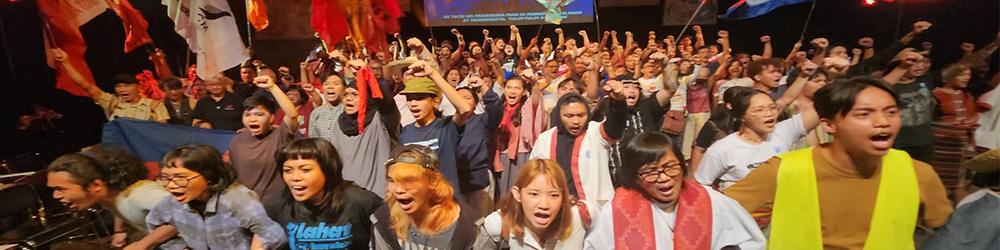
Throughout the 1980s, Clark and Subic became centers of protest. Large mass actions were led by various sectors — youth, workers, peasants, women, and the church. Aside from national democrats, other political forces joined the broad anti-bases alliances. Wide coalitions were formed such as the Nuclear Free Philippines Coalition, Anti-Bases Coalition, Anti Baseng Kilusan (ABAKADA), and Anti-Treaty Movement.
In 1989, the NPA assassinated Col. James Rowe, chief of the JUSMAG army division which provided counter-insurgency training for the Philippine armed forces in tandem with the U.S. Central Intelligence Agency.
All these actions laid the foundation for the most important victory on September 16, 1991 when the Philippine Senate voted to end the RP–U.S. Military Bases Agreement. Despite heavy pressure from the Corazon Aquino regime, Washington, and the powerful pro-bases lobby, thousands of people took to the streets to opposed a new bases treaty. Twelve senators voted against the RP–U.S. Treaty of Friendship, Cooperation and Security that would have extended the stay of the military bases for another 10 years.
The Senate vote was the product of a long, broad, and militant mass movement that expressed opposition in the streets, in various communities, and through various forms of struggle. That day marked a victory for national sovereignty — proof that the people can assert their independence and right to self-determination against a giant foreign power.
The new face of U.S. military presence
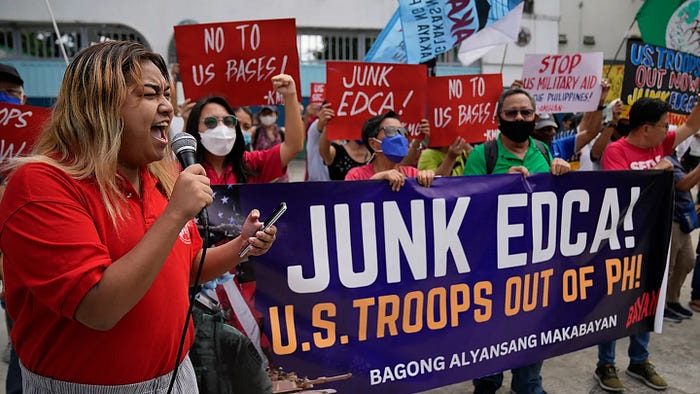
The bases may have been dismantled, but the presence and influence of the U.S. military remained. By 1999, a Visiting Forces Agreement was signed followed by annual joint military exercises called Balikatan. This was followed by the Mutual Logistics Support Agreement in 2002, the Enhanced Defense Cooperation Agreement in 2014, and a new version of the Bilateral Security Agreement between the U.S. and the Philippines in 2024.
Thus since 2001, endless military exercises have been held between US and Philippine troops. Next year, more than 500 exercises are scheduled, even more than the number of days in a year.
To date, nine EDCA sites — technically Philippine bases housing US troops and military facilities — have transformed the entire country into a forward base complex, including missile systems and communications and intelligence facilities. Coming up is a U.S. ammunitions factory, ship maintennance and repair facilities, and a military-industrial corridor along the Philippine west coast.
There have been various pretexts for the presence of U.S. troops and bases in Philippine soil — it was anti-communism during the Cold War, “counterterrorism” during the War on Terror, “mutual defense” with the rising threat of Chinese expansionism, and “humanitarian aid and disaster relief” in the era of climate change. But the truth is that these are used to deepen and widen U.S. control over the region’s economy, politics, and security.
Worse, thousands of Filipinos have become victims of human rights violations and breaches of international humanitarian law under the guise of a “war against insurgency and terrorism” designed under the U.S. counterinsurgency guide.
The danger of U.S. imperialist wars
W e view the return of U.S. troops and military bases within the broader context of the U.S.’s global maneuvers including its instigation of Russia to invade Ukraine, its support of the colonial and genocidal regime in Israel, coups and embargoes against Carribean countries like Venezuela that resist U.S. hegemony, and using the Philippines as a pawn in its dangerous rivalry with China.
All these bring not peace or security but oppression and war.
Comrades, history clearly teaches us: true freedom is not granted — it is fought for. The ouster of the US bases in 1991 was achieved through the broad mass struggles of our people. We achieved victory because we effectively linked our struggle for democracy, social justice and reform to the struggle for national liberation against imperialism. This struggle was fought on all fronts — from legal, parliamentary struggles; militant street actions, to armed revolution.
Today imperialism and fascism continues to wreak havoc on the world. That is why we have to intensify our global struggle to smash imperialism and defeat fascism.