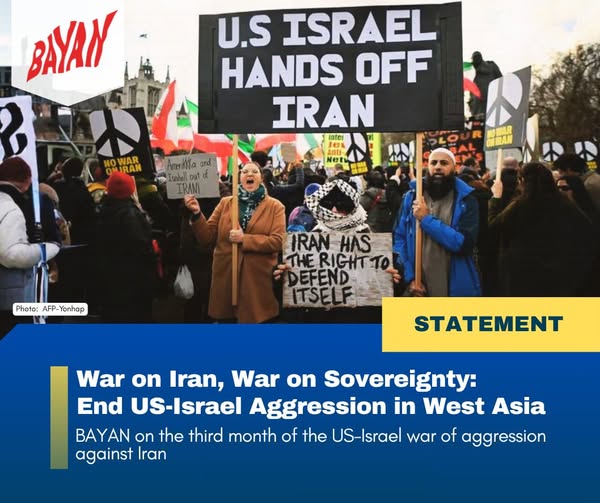
Three months since the United States and Israel launched their war of aggression against Iran on February 28, the peoples of the world continue to witness the catastrophic consequences of imperialist war: widespread destruction, deepening instability across West Asia, disruptions in global trade and energy supply, and the intensification of militarism under the pretext of “security” and “peace.”
The war against Iran unfolds alongside the continuing devastation of Palestine, where Israel’s genocidal assault persists through mass displacement, starvation, siege, and relentless bombardment. At the same time, military attacks against Lebanon continue to violate its sovereignty and threaten wider regional escalation. Far from containing violence, US-backed militarism has expanded war across borders, leaving entire peoples to bear the immense human cost of imperialist aggression.
The real target: sovereignty and independent development
Despite sustained bombardment, sanctions, diplomatic coercion, and efforts at political isolation, Iran continues to assert its national sovereignty and resist imperial domination. The endurance of the Iranian people affirms a truth long understood by peoples struggling against empire: nations subjected to siege and aggression resist not simply to survive, but to defend their right to self-determination, independent development, and national dignity.
This war has never been about Iran’s development of nuclear weapons. For decades, the United States has targeted countries that refuse subordination to imperial hegemony, particularly those that assert independent political, economic, scientific, and technological development. Since the 1979 Iranian Revolution that toppled the Western-backed Shah, Iran has pursued a path marked by national sovereignty, strategic self-reliance, and resistance to foreign domination. It is precisely this insistence on independent development—despite sanctions, sabotage, and isolation—that has made Iran a persistent target of imperialist aggression.
Diplomacy under bombs is not peace
The present conflict further exposes the hypocrisy of Washington’s posture toward negotiations. Diplomacy cannot be credible while accompanied by siege conditions, military encirclement, coercive demands, and continued bombardment. Negotiations under the shadow of force reveal not a genuine commitment to peace, but an attempt to compel surrender to imperial dictates. The language of diplomacy is repeatedly invoked while a war of aggression remains the principal instrument of policy.
The war comes home: crisis, neocolonialism, and Pax Silica
The consequences of this war are not confined to Iran or West Asia. Oil price shocks, disruptions in maritime trade, and deepening global instability have worsened inflation and raised the costs of fuel, food, transport, and basic necessities especially in dependent economies like the Philippines. Once again, it is workers, transport groups, fisherfolk, peasants, and the urban poor who bear the burden of a crisis they have no hand in.
Yet the Marcos Jr. government has failed to decisively shield the Filipino people from spiraling prices and economic insecurity; that is, the worsening of already burdensome conditions. Instead of instituting policies for effective economic relief, energy security, national industrialization and a self-reliant economy, the regime remains pliant to US dictates and aligned with US geopolitical priorities. Ordinary Filipinos absorb the socioeconomic costs of war and neocolonial conditions.
Insidiously, the Marcos regime deepens military and technological dependence through strategic alignment with the United States under projects such as Pax Silica. Presented as innovative and key to economic development, this framework increasingly binds Philippine technological and industrial policy to foreign capital, military logistics, AI surveillance, extractive supply chains, and counterinsurgency. Its growing links to Israeli and US technology and security interests expose the deeply militarized character of this so-called development agenda. While the Philippines is encouraged to barter its sovereignty for investment from aggressor states, technology becomes increasingly subordinated to securitization, militarism, and geopolitical rivalry rather than genuine national development.
Iran’s pursuit of independent scientific and technological advancement stands in sharp contrast to this neocolonial model. Despite sanctions and sustained economic warfare, Iran has sought to develop domestic capacities in science, medicine, energy, and industry in ways anchored in sovereignty and self-reliance. Where Pax Silica deepens dependence and securitized governance, independent development seeks to place science and technology in the service of national sovereignty and collective social need.
Stand with Iran, Palestine, and the peoples of West Asia
BAYAN stands firmly with the people of Iran in resisting the US-Israel war of aggression. We reaffirm our unwavering solidarity with the people of Palestine, Lebanon, and all nations struggling against occupation, fascism, imperialist war, and colonial domination.
We call on the Filipino people to reject the Marcos regime’s collaboration with aggressor states, oppose the militarization of our country, expose and resist the US-backed counterinsurgency program that unleashes terror against the people, oppose neocolonial technological dependency, and strengthen the movement for peace founded on sovereignty, justice, and genuine self-determination.
End the US-Israel war of aggression against Iran!
Stop the genocide in Palestine and attacks on Lebanon!
Reject imperialist war, fascist militarism, and neocolonial domination!
Stand for people’s sovereignty, just peace, and international solidarity!